

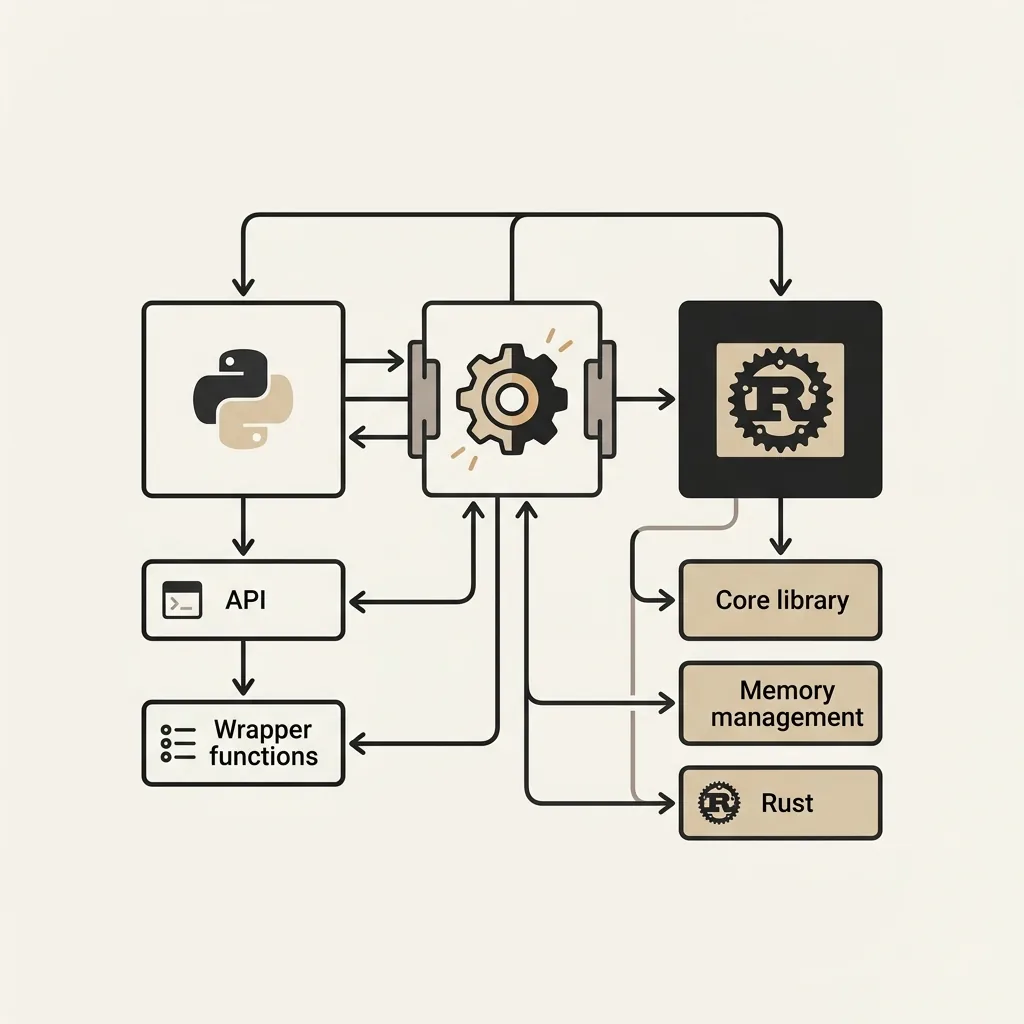
PythonSTL is a dual-engine library replicating C++ STL container semantics and algorithms in Python, dynamically delegating operations between a pure-Python fallback (using AVL trees) and an optimized, compiled Rust backend (using B-trees via PyO3/Maturin) to showcase hybrid architecture patterns and FFI optimization trade-offs.
1. Overview & Motivation
Developers transitioning from C++ to Python often face a surprising gap: Python lacks native sorted associative containers. While Python's built-in set and dict types offer average O(1) lookup speeds using hash tables, they are completely unordered. If you need to keep a collection dynamically sorted while executing range queries or lower/upper bound lookups, you are forced to re-sort lists (O(N log N)) or rely on complex external wrappers.
Furthermore, Python's standard heapq is strictly a min-heap implementation, offering no built-in max-heap or custom element comparators without boilerplate-heavy wrapper classes.
To solve these problems and create a learning template for hybrid software systems, I developed PythonSTL. The library exports six core containers with standard C++ signatures:
- stack: LIFO adapter.
- queue: FIFO adapter.
- vector: Dynamic array with explicit capacity control.
- stl_set: Sorted associative container storing unique elements.
- stl_map: Sorted key-value store.
- priority_queue: Min/max-heap supporting custom comparators.
It also includes replicas of core STL algorithms like next_permutation, nth_element (Quickselect), and binary search utilities.
2. User Journey & API Signatures
Installing the library is as simple as pip install pythonstl. Below is a side-by-side comparison highlighting how PythonSTL bridges the gap between C++ semantics and Python interfaces.
std::vector<int> v;
v.push_back(100);
v.reserve(1000);  // Explicit memory allocation
v.shrink_to_fit();
from pythonstl import vector

v = vector()
v.push_back(100)
v.reserve(1000)      # Memory reservation
v.shrink_to_fit()    # Truncate unused buffer
3. The Facade Design & Dual-Engine Routing
To maintain absolute cross-platform availability, PythonSTL follows a Facade Design Pattern. The user always interacts with a clean Python API. Under the hood, the facade dynamically evaluates the execution environment:
Interactive Engine Routing Diagram
Toggle the backend state to see how the facade routes operations.
stl_setRust Path: If PyO3 extensions are compiled successfully and use_rust=True is set, the class instantiates _rust.RustSet. Operations are written in native Rust BTreeSet collections, bypassing the Python VM for primitive sorting operations using direct FFI compilation.
Design Pattern Choice: Why Facade Pattern over MVC or Direct Bindings?
A common question is why PythonSTL uses the Facade Pattern rather than architectural patterns like MVC (Model-View-Controller) or exposing direct C-extension bindings:
- Why not MVC? MVC is engineered for interactive GUI applications to decouple data models, visual presentation (views), and user input handlers (controllers). For a backend data-structures library, there are no views or controllers. Applying MVC would introduce unnecessary abstraction layers and operational overhead.
- Why Facade? The Facade pattern provides a single, unified interface (
stl_set,vector) that hides complex internal routing mechanics. Developers get identical C++ STL method signatures without needing to know whether execution is currently running inside compiled Rust native code or pure-Python AVL tree fallbacks. - Why not Direct Bindings? Binding compiled Rust classes directly into Python (
import _rust) would force installation to fail on systems lacking compiler toolchains or pre-built wheels. The Facade guarantees 100% platform compatibility.
4. FFI Bindings & GIL Management
Rust compiled modules communicate with CPython through PyO3 and the Maturin build compiler. Managing reference count operations at the FFI boundary is crucial. Every arbitrary Python object loaded into a Rust-managed collection is held as a PyObject, which is an incremented smart-pointer to the Python heap.
Sorting Python Objects in Rust: The PyObjectOrd Wrapper
Rust's standard B-Tree collection requires keys to implement the standard Ord comparison trait. Since a raw Python object comparison requires holding the Global Interpreter Lock (GIL) and calling standard Python methods, we must implement a wrapper to safely manage this boundary:
struct PyObjectOrd(PyObject);

impl Ord for PyObjectOrd {
    fn cmp(&self, other: &Self) -> Ordering {
        Python::with_gil(|py| {
            let self_ref = self.0.bind(py);
            let other_ref = other.0.bind(py);

            // Fast-path extraction for primitives to bypass CPython RichCompare
            if let (Ok(a), Ok(b)) = (self_ref.extract::<i64>(), other_ref.extract::<i64>()) {
                return a.cmp(&b);
            }
            if let (Ok(a), Ok(b)) = (self_ref.extract::<&str>(), other_ref.extract::<&str>()) {
                return a.cmp(&b);
            }

            // Fallback: Invoking Python comparison logic via FFI C-API
            if self_ref.eq(other_ref).unwrap_or(false) {
                Ordering::Equal
            } else if self_ref.lt(other_ref).unwrap_or(false) {
                Ordering::Less
            } else {
                Ordering::Greater
            }
        })
    }
}
Primitive Fast-Path Optimization
Calling PyObject_RichCompareBool requires wrapping arguments, performing internal symbol lookups, and checking interpreter scopes. By dynamically checking if the pointer represents standard primitive types (int, str, etc.) and extracting values directly into Rust-allocated bytes, we bypass CPython VM lookups completely. This logic yields up to a 7x speedup for standard collection lookups.
Technology Choice: Why Python + Rust Hybrid instead of Pure Rust or Pure Python?
Pure Rust forces users to compile native binaries, giving up Python's rapid prototyping, dynamic scripting, and massive data science ecosystem (Jupyter, Pandas, PyTorch).
Pure Python data structures suffer from high object allocation overhead, pointer chasing, and interpreter loop slowness during heavy mutations or sorting operations.
Delivers Python ergonomics for clean API imports, zero-cost Rust abstractions for $O(N)$ bulk loops (up to 190x speedup), and automatic pure-Python fallbacks for 100% platform portability.
5. The Pure Python Fallback Engine: AVL Trees
When a compiled Rust backend is not available, we require an ordered set/map implementation with logarithmic complexity guarantees. PythonSTL implements a self-balancing binary search tree—specifically, an AVL Tree—written in pure Python under pythonstl/core/avl_tree.py.
An AVL tree enforces a strict balance invariant: the heights of two child subtrees from any node can differ by at most one:
When an insertion or deletion breaks this constraint, the tree uses four structural rotations to rebalance nodes:
- Left-Left (LL) Case: A single right rotation is executed.
- Right-Right (RR) Case: A single left rotation is executed.
- Left-Right (LR) Case: A double rotation (left rotation on left child, right rotation on parent).
- Right-Left (RL) Case: A double rotation (right rotation on right child, left rotation on parent).
6. Quickselect & Pivot Selection Safety
The library replicates the standard C++ nth_element algorithm, which rearranges elements so that the value at the $n$-th index matches its sorted position. It is implemented using the Quickselect selection algorithm.
A naive implementation of Quickselect using a Lomuto partitioning scheme (with the rightmost element as the pivot) degrades to a quadratic complexity of O(N²) when sorting pre-sorted or reversed lists. In our initial test suites, this caused severe slowdowns (up to 70.85 seconds) on large data ranges.
To solve this, we implemented a Middle Pivot Selection Strategy. Before partitioning, the middle element is selected and swapped to the end:
let pivot_idx = left + (right - left) / 2;
arr.swap(pivot_idx, right);
This modification ensures average-case O(N) execution times, drastically reducing runtime on pre-sorted arrays of size 100,000 from 70.85 seconds down to 0.0064 seconds—a speedup of over 11,000x!
7. Performance Benchmarks & FFI Overhead
To evaluate the efficiency of our hybrid compilation approach, we built a comparative performance harness testing the Pure-Python fallback, the Rust-backed engine, and Python's native structures.
| Workload / Container | Pure Python Fallback | Python + Rust Engine | Python Native Baseline | Rust Speedup |
|---|---|---|---|---|
| Stack (1M push/pop) | 0.4768s | 0.3227s | 0.0530s (list.pop) | 1.48x |
| Vector (10k push_back) | 0.2296s | 0.1374s | 0.0444s (list.append) | 1.67x |
| Map (10k insert - int) | 0.0873s | 0.0116s | 0.0019s (dict[key]) | 7.53x |
| Map (10k find - int) | 0.0077s | 0.0046s | 0.0018s (key in dict) | 1.68x |
| Bubble Sort (10k elements) | 3.8210s | 0.0201s | N/A | 190.1x |
Key System Insights & Bottleneck Analysis
Evaluating the benchmarks reveals two key systems-level behaviors:
- FFI Boundary Limits: For fast O(1) mutations like
stack.push(), the compiled Rust engine is only marginally faster (1.48x). This is because the execution overhead required to cross the CPython FFI boundary dominates the performance. The speedup becomes massive (190x) for bulk processing likebubble_sortbecause the collection crosses the boundary exactly once, executing the entire O(N²) nested loop in native machine code. - Sorted Trees vs. Hash Tables: Our sorted
stl_mapis slower than Python's nativedict. This is because dictionary indexing uses a highly optimized C-level hash table (average O(1) complexity), while B-Tree sets and maps require O(log N) tree node comparisons, which are bound by GIL acquisition checks.
8. Memory Safety & Thread Safety Constraints
Unlike native C++ where invalid vector indexing (e.g. v[idx]) can trigger buffer overflows or memory segmentation faults, PythonSTL implements strict safety wrappers:
- Bounds Verification: The vector facade and Rust bindings perform explicit index inspections on every indexing request. If boundaries are violated, an
OutOfRangeErrorexception is raised safely before a pointer mutation occurs. - Thread-Safety Limitations: Despite having a backend written in Rust, the collections are not thread-safe. Every mutation modifying a
PyObjectrequires acquiring Python's GIL. Mutating these containers from parallel threads without synchronizing via a Python-sidethreading.Lock()will trigger CPython memory race conditions.
9. Key Architecture & Technology Trade-offs
A detailed one-by-one analysis of the architectural design decisions and performance trade-offs made in PythonSTL.
Facade Pattern vs. MVC & Direct Bindings
01MVC separates dynamic UI state from presentation layers—an anti-pattern for a backend data structure library. The Facade pattern provides a single, unified C++ STL contract while masking internal FFI compilation checks, runtime engine selection, and automatic pure-Python fallback dispatch.
Python + Rust Hybrid vs. Pure Rust / Pure Python
02Pure Rust sacrifices Python's developer ergonomics, REPL access, and data science ecosystem. Pure Python suffers from pointer-chasing and interpreter overhead. The hybrid model provides Python ease of use with native Rust execution speed (up to 190x speedup for bulk operations) and 100% portable fallbacks.
AVL Trees vs. Red-Black Trees (Python Fallback)
03AVL trees enforce strict height balancing (|height(left) - height(right)| ≤ 1), guaranteeing shorter tree heights and faster O(log N) search traversals. In interpreted Python, minimizing node comparison iterations is more critical than reducing rebalancing rotations.
B-Trees vs. Binary Trees (Rust Cache Locality)
04Rust's BTreeSet groups multiple elements into contiguous node arrays. On modern CPU architectures, array layout maximizes L1/L2 cache line hits and minimizes RAM pointer chasing compared to heap-allocated node pointers.
PyO3 + Maturin vs. Cython / Ctypes
05PyO3 provides compile-time memory safety, automatic GIL acquisition (Python::with_gil), and zero unsafe boilerplate for CPython reference counting. Paired with Maturin, building cross-platform wheel binaries is completely automated.
Quickselect Middle-Pivot vs. Lomuto Pivot
06Selecting the array midpoint as the Quickselect pivot eliminates O(N²) worst-case call stack degradation on pre-sorted data. Benchmark testing showed execution time dropping from 70.85s to 0.0064s (an 11,000x acceleration).
10. Common Myths vs. Technical Reality
Addressing common misconceptions around hybrid Python-Rust libraries, performance expectations, and CPython internals.
Myth 1: "Useless since LeetCode/Codeforces block external imports."
Reality: True for online judges, but that misses the core objective. PythonSTL is built for local prototyping—helping C++ developers translate their STL mental model directly into Python while sharpening data structure design before technical interviews.
Myth 2: "Python's built-ins make the Rust backend pointless."
Reality: Python has no native sorted set or map (dict and set are unordered hash tables) and heapq is strictly a min-heap. PythonSTL adds true O(log n) BTreeSet/BTreeMap containers and flexible heaps—following the exact same high-performance hybrid pattern used by Polars, Pydantic, and Cryptography.
Myth 3: "Rust backend is always faster."
Reality: Not for fine-grained O(1) operations like single element push/pop, where FFI boundary crossing overhead dominates. Rust wins massively on compute-heavy workloads: sorting, partitioning, and binary search over large datasets where the FFI bridge is crossed once.
Myth 4: "Rust makes it thread-safe."
Reality: No. Containers store PyObject handles and still evaluate comparisons through the GIL. Concurrent mutations across parallel threads without a Python-side threading.Lock still risk CPython memory data races.
Myth 5: "stl_set / stl_map replace Python set / dict."
Reality: Different tools for different workloads. Python's built-ins are average O(1) unordered hash tables; PythonSTL's stl_set and stl_map are O(log n) sorted trees designed specifically for when you need dynamic ordering or range queries (lower_bound / upper_bound).
Myth 6: "Rust backend avoids memory/refcounting issues."
Reality: False. PythonSTL still holds PyObjectreferences inside Rust containers and must obey CPython's refcounting and garbage collection rules, including circular reference handling.